When portraying a man of the cloth, it is important to start with the right materials in the construction of your habit. In Saint Francis’ third and final rule for the ordo fratrum minorum, it was stipulated that “...those who have promised obedience take one tunic with a hood, and let those who wish it have another without a hood….All the brothers are to wear inexpensive clothing, and they can use sackcloth and other material to mend it with God's blessing.”[1] Ever since, the use of coarse woolen sackcloth has been an integral part of the Franciscan experience.
In Spanish the term for sackcloth is sayal, and at the time of the La Florida missions (1573-1763) was the fabric most used in the habits of these Franciscan friars. Despite its widespread employment, however, no known example of sayal survives today as its use declined toward the end of the eighteenth-century and has not been manufactured since.[2] So what do we know about sayal? Is the Spanish sayal at the time of the missions the same as the sackcloth used by the earliest Franciscans, or did it change over the almost 600 years “sackcloth” was in use by the friars? What exactly is sayal? And how do we incorporate what we know in reproducing an appropriate habit for doing living history portrayals as a Florida Franciscan friar?
Saint Francis’ Sackcloth
The adoption of sackcloth into the Rule of 1223 by Saint Francis was rooted in his own religious development. Habited in “a sort of hermit's attire, a leather belt around his waist and a staff in his hands, and… wearing shoes,” Saint Francis focused on renovating a number of dilapidated chapels around Assisi for the three years following his conversion at San Damiano.[3] While Francis was involved in repairing the Portiuncula chapel, however, a priest arrived and preached on the gospel tale in Matthew 10: 9-10, where Jesus sends his disciples into the world without money, bags, extra tunics, staffs, or shoes. According to the chronicler Thomas of Celano,
Francis, rejoicing in the spirit of God, said, "This is what I want! This is what I'm looking for! This is what I want to do from the bottom of my heart!" Thus the holy father, overflowing with joy, hurried to fulfill those healing words….He took off his shoes, tossed away his staff, was satisfied with a single tunic, and exchanged his leather belt for a cord. He made himself a tunic that looked like the cross so that he could beat off the temptations of the devil. It was rough in order to crucify the vices and sins of the flesh. It was poor and mean so that the world would not covet it. With the greatest diligence and reverence he tried to do everything else that he had heard, for he was not a deaf hearer of the gospel but, laudably committing all that he had heard to memory, he diligent1y attempted to fulfill them to the letter.[4]
This rough, poor, tunic was most likely sackcloth or very similar to it, and was eventually adopted by the rest of the early Franciscan community.
In Spanish the term for sackcloth is sayal, and at the time of the La Florida missions (1573-1763) was the fabric most used in the habits of these Franciscan friars. Despite its widespread employment, however, no known example of sayal survives today as its use declined toward the end of the eighteenth-century and has not been manufactured since.[2] So what do we know about sayal? Is the Spanish sayal at the time of the missions the same as the sackcloth used by the earliest Franciscans, or did it change over the almost 600 years “sackcloth” was in use by the friars? What exactly is sayal? And how do we incorporate what we know in reproducing an appropriate habit for doing living history portrayals as a Florida Franciscan friar?
Saint Francis’ Sackcloth
The adoption of sackcloth into the Rule of 1223 by Saint Francis was rooted in his own religious development. Habited in “a sort of hermit's attire, a leather belt around his waist and a staff in his hands, and… wearing shoes,” Saint Francis focused on renovating a number of dilapidated chapels around Assisi for the three years following his conversion at San Damiano.[3] While Francis was involved in repairing the Portiuncula chapel, however, a priest arrived and preached on the gospel tale in Matthew 10: 9-10, where Jesus sends his disciples into the world without money, bags, extra tunics, staffs, or shoes. According to the chronicler Thomas of Celano,
Francis, rejoicing in the spirit of God, said, "This is what I want! This is what I'm looking for! This is what I want to do from the bottom of my heart!" Thus the holy father, overflowing with joy, hurried to fulfill those healing words….He took off his shoes, tossed away his staff, was satisfied with a single tunic, and exchanged his leather belt for a cord. He made himself a tunic that looked like the cross so that he could beat off the temptations of the devil. It was rough in order to crucify the vices and sins of the flesh. It was poor and mean so that the world would not covet it. With the greatest diligence and reverence he tried to do everything else that he had heard, for he was not a deaf hearer of the gospel but, laudably committing all that he had heard to memory, he diligent1y attempted to fulfill them to the letter.[4]
This rough, poor, tunic was most likely sackcloth or very similar to it, and was eventually adopted by the rest of the early Franciscan community.
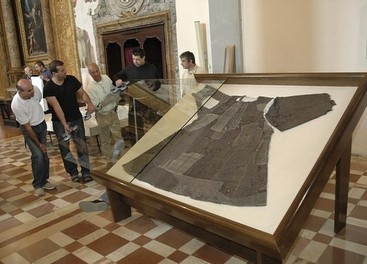
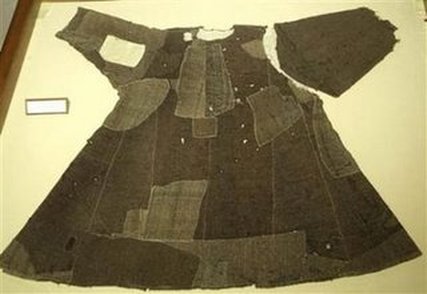
A number of tunics that have been attributed to Saint Francis remain in existence. The first is housed in the Basilica Papale di San Francesco d’Assisi, in Assisi, Italy. It is unique in that it is made of slightly fulled twill wool, and is partially lined in linen. This particular tunic also has more of a secular cut to it, being closer to a kyrtle or frock from the early 13thC than a religious habit. Assuming this garment actually was worn by Saint Francis, it would most likely be a candidate for the habit he wore during his first three years of chapel renovations. A fulled twill wool would have been a poor quality cloth from that which Francis had worn in secular life, but was still a finer cloth than the woolen sackcloth he would adopt at the Portiuncula. For more detailed information on this tunic, please visit I. Marc Carlson’s page at http://www.personal.utulsa.edu/~marc-carlson/cloth/francis.htm. The photos here are from a 2007 Reuter’s article and taken by Daniele la Monaca.[5]
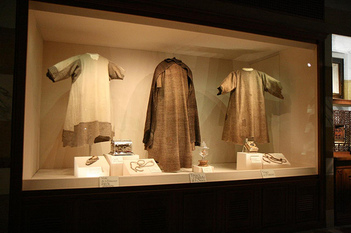
This next picture is also from Assisi, showing Franciscan relics on display at the Basilica di Santa Chiara.[6] I have not been able to find out any information on the tunic fragments at left, but the middle habit is suppose to be the tunic and cloak of Saint Clare. On right is the tunic claimed to have been worn by Saint Francis, along with a breviary and cincture attributed to him as well.
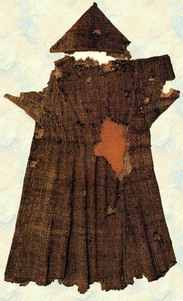
This next habit attributed to Saint Francis comes from the Sanctuary of La Verna, which was built near the location Francis received the stigmata. For more information on the tunic itself, see http://digilander.libero.it/ancilla/english/laverna/saio.html.
These next two tunics attributed to Saint Francis are most interesting, as they have been the only ones to undergo carbon-14 dating in an attempt to explore their authenticity. The tunic in front belongs to Santa Croce church in Florence, and the one behind is possessed by the Church of San Francesco on via barrettini in Cortona, Italy.
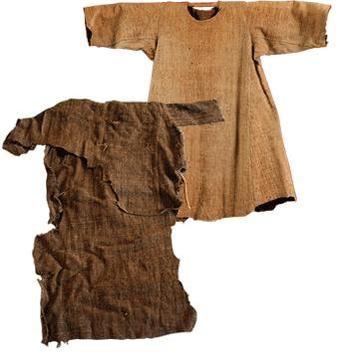
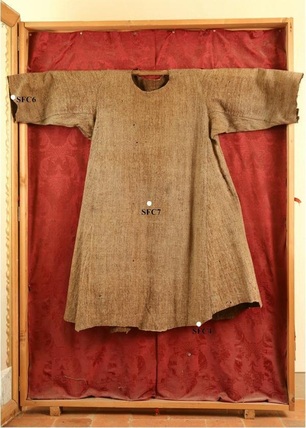
Based on the results of the 2007 carbon-14 testing, the Cortona tunic shown left was found to date between 1155 and 1225, which falls within the lifetime of Saint Francis. While there is no way to prove the tunic actually was worn by Francis, the fact that it dates to the correct time and is thought to have been brought to Cortona by Brother Elias along with a cushion and book of gospels (which also date to the same era), increases the likelihood.
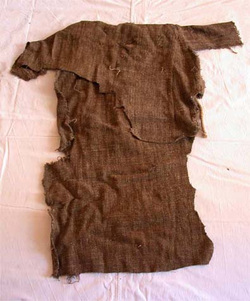
While it was also attributed to Saint Francis, the tunic from Santa Croce in Florence was shown to post-date the life of Saint Francis through the Carbon-14 study. Saint Francis died in 1226, but the dates on the tunic ranged between the end of the 1200s and the end of the 1300s, meaning its possible date of manufacture was around 80 years after his death. For more information on the study, please see http://www.sciencedaily.com/releases/2007/09/070909092349.htm. (Picture at: http://www.kostym.cz/Anglicky/1_Originaly/01_Goticke/I_01_101.htm)
A fragment of the Santa Croce tunic is all that is on display, along with a cincture which was also attributed to Francis.
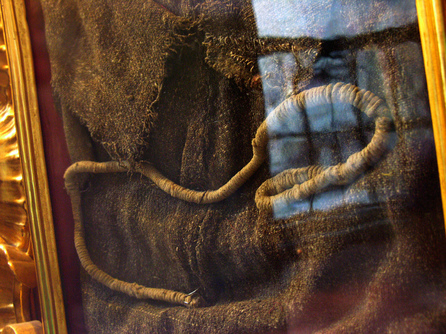
Regardless of whether these tunics were actually worn by Saint Francis, they are the only examples of early habits that have managed to survive the centuries. As seen in the pictures, they are all made of very coarse woolen materials, various shades of mid-grey in color, and are all plain woven. But is the fabrics used in these early habits the same as what was used by Spanish Friars between 1573 and 1763? We will continue our exploration in part II....
[1] http://www.fordham.edu/halsall/source/stfran-rule.html
[2] http://www.spanishcolonial.org/page54.php
[3] http://www.fordham.edu/halsall/source/stfran-lives.html
[4] Ibid.
[5] http://www.reuters.com/article/2007/09/05/us-italy-saint-idUSL0586082220070905
[6] http://www.sacred-destinations.com/italy/assisi-santa-chiara-pictures/slides/xti_0837.htm
[2] http://www.spanishcolonial.org/page54.php
[3] http://www.fordham.edu/halsall/source/stfran-lives.html
[4] Ibid.
[5] http://www.reuters.com/article/2007/09/05/us-italy-saint-idUSL0586082220070905
[6] http://www.sacred-destinations.com/italy/assisi-santa-chiara-pictures/slides/xti_0837.htm
 RSS Feed